Robot Arm Ecosystem
A comprehensive EMG-controlled robotic platform combining embedded firmware, machine learning, and mobile app development — funded through the YTÜ Yıldız Kaşifleri innovation program.
Overview
Secured funding to develop a complete robot arm control ecosystem featuring:
- Embedded control firmware (C++) for precise servo actuation
- React Native companion app for real-time operation and monitoring
- Machine learning pipeline mapping EMG bio-signals to motion
Architecture
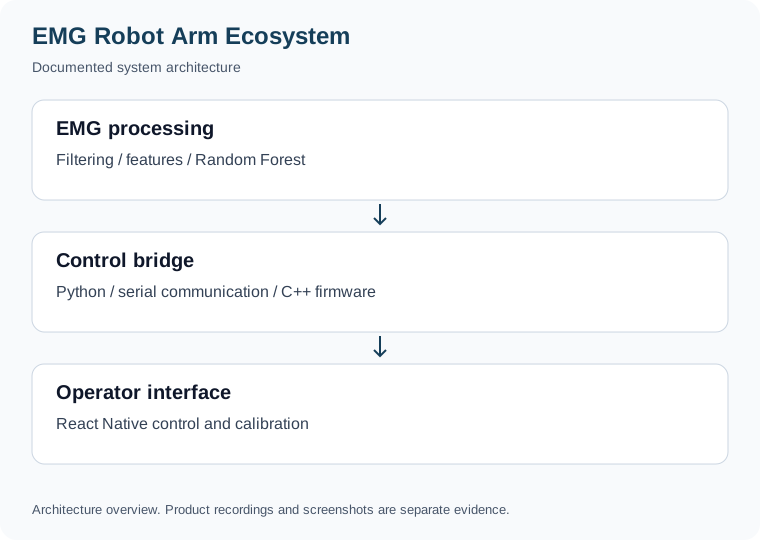
Architecture overview, not a product screenshot.
Embedded Firmware (C++)
  ├─ Inverse Kinematics solver
  ├─ Servo control protocol
  ├─ Serial communication interface
  └─ Safety & calibration modes

React Native App
  ├─ Live EMG visualization
  ├─ Control panel (mode, sensitivity)
  ├─ Calibration workflow screens
  └─ Haptic / visual feedback

Python Backend
  ├─ EMG signal acquisition & filtering
  ├─ Feature extraction (RMS, thresholds)
  ├─ Random Forest gesture classification
  └─ Serial bridge to embedded system
Key Contributions
- Designed embedded control firmware (C++) with precise servo actuation
- Implemented Inverse Kinematics for natural arm movement
- Trained Random Forest models to map EMG bio-signals to servo motion
- Built Python serial communication bridge synchronizing mobile and embedded systems
- Developed intuitive React Native UI for real-time control and feedback
Technical Highlights
- Bio-signal processing: Notch filtering, bandpass filtering, feature extraction
- ML pipeline: Random Forest gesture classification with confidence thresholds — 94% accuracy across our test runs
- Real-time sync: Low-latency communication between app, Python backend, and firmware
- Safety features: Emergency stop, calibration modes, sensitivity controls
Impact
Demonstrates end-to-end integration of biosignal processing, embedded systems, and mobile development for accessible human-machine interaction.
Evaluation Scope
The 94% gesture-classification accuracy comes from our test logs, measured across repeated test runs of the Random Forest classifier during development. It is a project test result, not a clinical or multi-user validation.